Proposal for Institutional Placement / Scholarly Partnership
The Anna Venidiktovna Voinova Archive
A 30-year research archive addressing a question Russian orthography still hasn't resolved — confirmed in print by the Russian Academy of Sciences as recently as 2022.
Prepared by Ilya Rozhdestvensky, grandson of Anna Venidiktovna Voinova · Hyannis, Massachusetts, USA · August 2026
“
«Одна из нерешённых проблем орфографии» — “One of the unresolved problems of orthography.”
E. V. Beshenkova, Institute of the Russian Language, Russian Academy of Sciences, Русский язык в школе, 2022.The same journal that published Anna Venidiktovna Voinova's own article on this exact question in 1982.
The Unresolved Question
In 2022, in the same journal that had published Anna Venidiktovna Voinova's own work forty years earlier, E. V. Beshenkova of the Institute of the Russian Language returned to a closely related aspect of the problem to which Voinova had devoted much of her scholarly career. Writing in Русский язык в школе, Beshenkova described the area under discussion as «одна из нерешённых проблем орфографии» — "one of the unresolved problems of orthography."
The continuity is particularly striking because the question had also recently been considered by the Orthographic Commission of the Russian Academy of Sciences. On 21 February 2021, Beshenkova presented «Антиномии языка в области написания н или нн в кратких отглагольных прилагательных» ("Antinomies of Language in the Writing of н or нн in Short Deverbal Adjectives") to the Commission. Discussion continued at a subsequent meeting that April, with the Commission determining that additional material should be examined before conclusions were drawn. This work was subsequently developed into the peer-reviewed article: E. V. Beshenkova, «Написание кратких форм отглагольных прилагательных на -нный: н или нн (из материалов академического описания русской орфографии)», Русский язык в школе, 2022, vol. 83, no. 4, pp. 80–85.
This does not mean that Voinova's research anticipated or resolves the questions being examined today. The linguistic scope and methodological context are not identical. It does, however, place the surviving archive in an unexpectedly contemporary scholarly context. Materials assembled several decades ago document a sustained empirical investigation of an area of Russian orthography that continues to attract attention from specialists.
There is a broader historical context as well. The 1956 rules, subsequent linguistic discussions, later attempts at revision and clarification, and contemporary academic resources such as «Академос» all belong to the continuing process by which Russian orthographic norms are described, codified, and reconciled with actual usage. The recurrence of questions involving н/нн in participial and adjectival forms illustrates the durability and complexity of this particular area of codification.
The correspondence archive also makes it possible to investigate another question: whether Voinova's project was simply overtaken by other scholarship.
Several rejection letters from 1980, 1983, and 1986 refer to a competing «Словарь русских причастий», under contract since 1977. The scholar associated with that project, Inna Kuzminichna Sazonova, was an established Soviet and Russian lexicographer. Her work eventually appeared in 1989 as «Русский глагол и его причастные формы: Толково-грамматический словарь» (Moscow: Русский язык), with subsequent editions in 2002 and 2008.
Sazonova's published work, however, addresses a substantially different lexicographic task: the formation, grammatical characteristics, and usage of Russian participial forms. It is not a specialized reference work devoted to the orthographic distinction between one н and two нн. Moreover, the specific title repeatedly cited in the correspondence with Voinova — «Словарь русских причастий» — does not appear to have been published under that title.
The closest later publication we have identified to a standalone reference devoted specifically to this spelling difficulty is «Одно Н или два? Ловушки орфографии» (comp. I. S. Ivanov, Moscow: Центрполиграф, 2010), a general-audience word list containing approximately 20,000 potentially difficult forms. Its purpose and structure are again substantially different from Voinova's project: it does not reproduce the citation apparatus, semantic and syntactic classification system, or extended linguistic argument documented in her surviving manuscript and research materials.
Taken together, these findings suggest a more interesting historical and scholarly question than whether Voinova's dictionary simply missed its opportunity for publication. Her archive preserves an unusually extensive attempt to investigate a difficult area of Russian orthography through a large body of collected usage, classification, comparison, and linguistic argument. Later publications addressed overlapping aspects of the problem, while closely related questions continue to be examined by contemporary orthographers.
The significance of the archive therefore cannot be established merely by the fact that the problem remains under discussion. Nor should Voinova's conclusions be assumed to be correct simply because of the scale of the surviving material. What the archive offers is something more concrete: a substantial historical research corpus through which specialists can examine how one scholar attempted, over several decades, to describe and systematize a persistent problem of Russian orthographic codification.
Whether that corpus contains observations or evidence of continuing value is ultimately a question for specialists in Russian orthography, lexicography, and the history of linguistic scholarship.
A Personal Note
My name is Ilya Rozhdestvensky. Anna Venidiktovna Voinova was my grandmother.
As a child, I watched her work on this dictionary for what felt like my entire childhood — surrounded by binders, index cards, and hand-ruled tables, endlessly cross-referencing citations from Pushkin and Paustovsky against her own classification of participles and adjectives. I did not understand then what she was building, only that it seemed to matter enormously to her, and that it never seemed to end.
She died in 1992.
We immigrated to the United States in the late 1990s. Somehow, through that move and through every family change since, this archive came with us — more than 30 binders and roughly a thousand individual research envelopes, carried across an ocean and stored for decades since. Over the years we made a few attempts to digitize it, but the material was too large, too handwritten, and the technology of the time was not equal to the task.
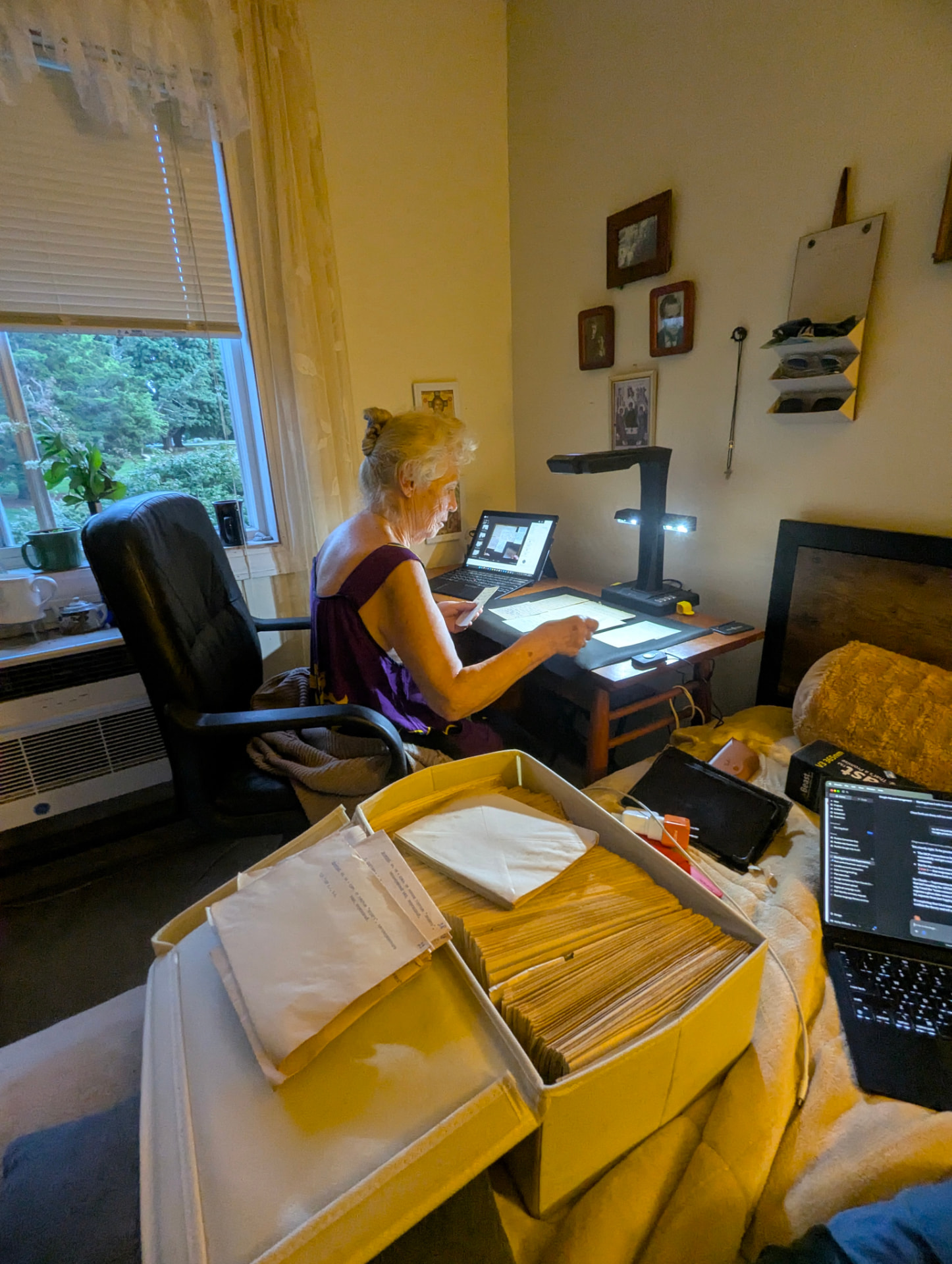
Only recently, with a high-speed CZUR scanner and the help of AI tools capable of reading, sorting, and cataloguing material at this scale, have we finally been able to process this archive properly and present it in full to people who might understand its value better than we do. What follows is the result of that effort — a good-faith attempt to show you what she built, and why we believe it deserves a permanent home.
— Ilya Rozhdestvensky
Grandson of Anna Venidiktovna Voinova
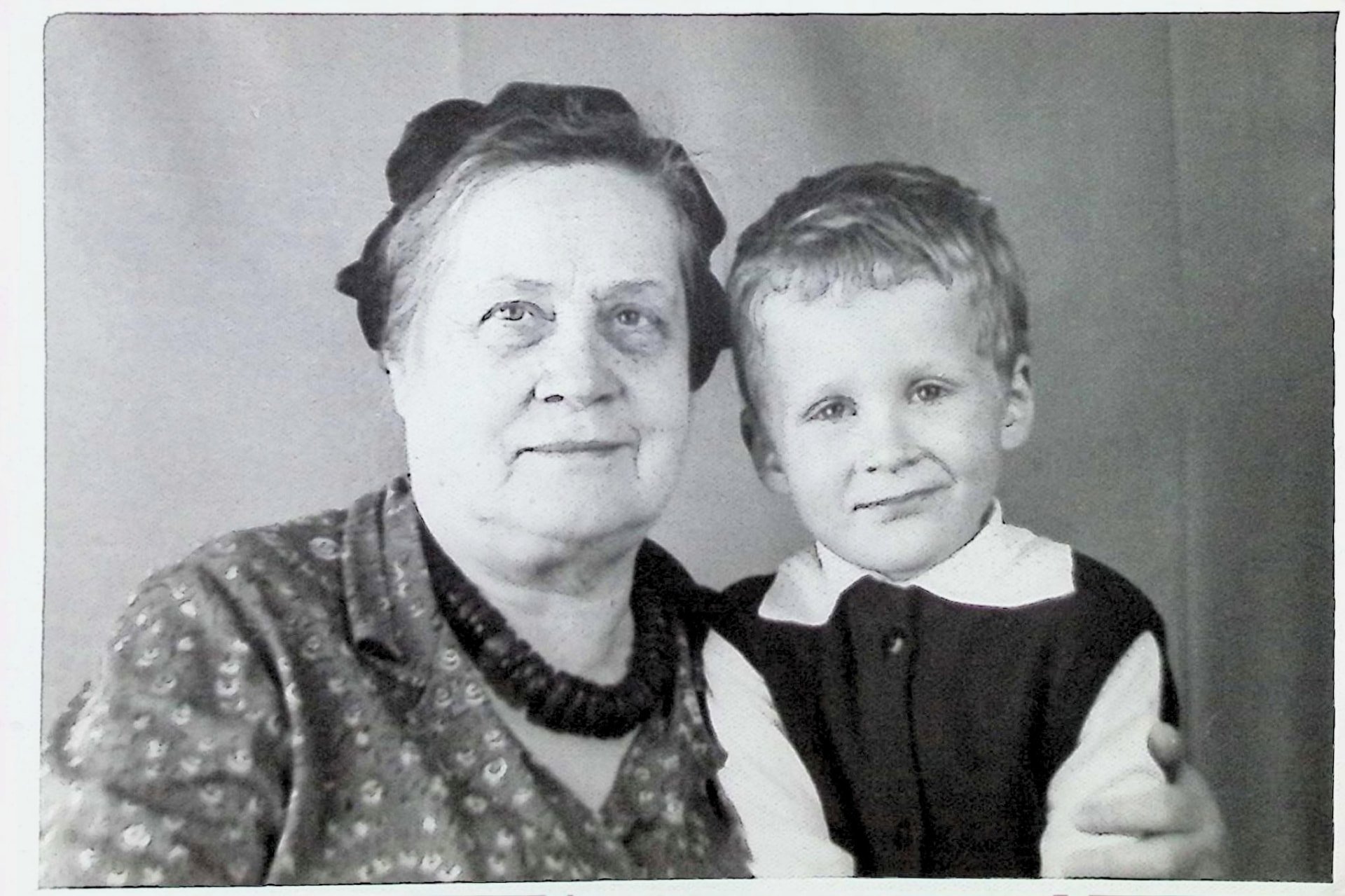
With my grandmother, Anna Venidiktovna Voinova, in the early 1970s — most likely 1972.
Executive Summary
This is an invitation to take up an unfinished piece of Russian linguistic scholarship. Anna Venidiktovna Voinova (1900–1992), a Moscow linguist and pedagogue, spent more than thirty years on one of the most persistently difficult problems in Russian orthography — when to write one н or two нн in participles and the adjectives derived from them. What she left behind is not a closed body of work but an open research opportunity: a complete, evidence-rich dictionary project awaiting the institution willing to study, finish, and publish it.
The archive is unusual in both depth and completeness. It preserves not just Voinova's conclusions but the entire research process behind them: roughly 1,000 individual lexical card envelopes recording citation evidence word by word, statistical tables, numbered comparative word-lists, a full unpublished dictionary manuscript, and — running alongside all of it — more than two decades of correspondence with Soviet publishers, the USSR State Committee for Publishing (Госкомиздат), the Institute of the Russian Language, and figures including Viktor Vinogradov, A. A. Reformatsky, and the novelist Yuri Bondarev.
The central irony of the collection is also its most compelling feature. The book-length dictionary Voinova spent her career building was never published — deferred repeatedly between 1967 and 1987, and, on the documentary record, usually not on the merits but because a competing work already held a contract. When a comparable reference dictionary did finally appear under another name, the field moved on without her evidence. Three of her articles distilling the same research did reach print in «Русский язык в школе,» the leading Soviet methodical journal for teachers of Russian — so the archive documents both a substantial scholarly achievement and a well-evidenced case study in how Soviet academic publishing decided what existed. See “The Unresolved Question” near the top of this page.
As of August 2026 the collection comprises more than 85 catalogued items across eight document series (manuscripts, articles, drafts and supporting documentation, correspondence, the editorial/research-evidence archive, biographical documents, methodology, and institutional records), summarized in the table below and listed in full, item by item, later in this document.
The physical collection — over 30 binders and roughly 1,000 individual card envelopes, currently held in Hyannis, Massachusetts — is partially digitized and fully described in a structured, cross-linked finding aid. This document summarizes the collection's scope and significance, presents a sample of its contents, and provides a complete item-level inventory of everything catalogued to date.
About Anna Venidiktovna Voinova
Anna Venidiktovna Voinova was born on 24 December 1900 in Mikhailovka, Sengileyevsky Uyezd, Simbirsk Province (present-day Ulyanovsk Oblast). Her father died during the Russo-Japanese War; her mother was a teacher of Russian language and literature. Voinova was educated at the First Women's Gymnasium in Syzran — the archive preserves a printed programme from a school musical evening there dated 29 November 1915, in which a piano performance by «А. Войнова» is listed, very likely her own earliest documented public appearance.
She moved to Moscow in 1921 and spent her working life within the Moscow Conservatory educational system, teaching at the Central Music School and its affiliated Uchilishche. Alongside this career in music pedagogy, she pursued original research into Russian orthography — specifically the participle/adjective distinction governing the н/нн suffix — for over three decades, corresponding with, and at points collaborating alongside, some of the leading Soviet linguists of the era.
The archive documents her repeated attempts, from at least 1967 through 1987, to secure publication for a full reference dictionary built on this research, as well as a formal joint proposal (with a co-author, D. F. Ivanova) to revise the relevant sections of the official 1956 Soviet orthographic code itself — evidence that her ambitions extended beyond a personal reference work into influencing Soviet language policy directly.
Biographical documents in the collection (series B) — a personnel record, a professional character reference, and a set of institutional certificates and testimonials spanning 1925 to 1972 — corroborate this career and provide independent, third-party confirmation of her professional standing, separate from her own research writing.
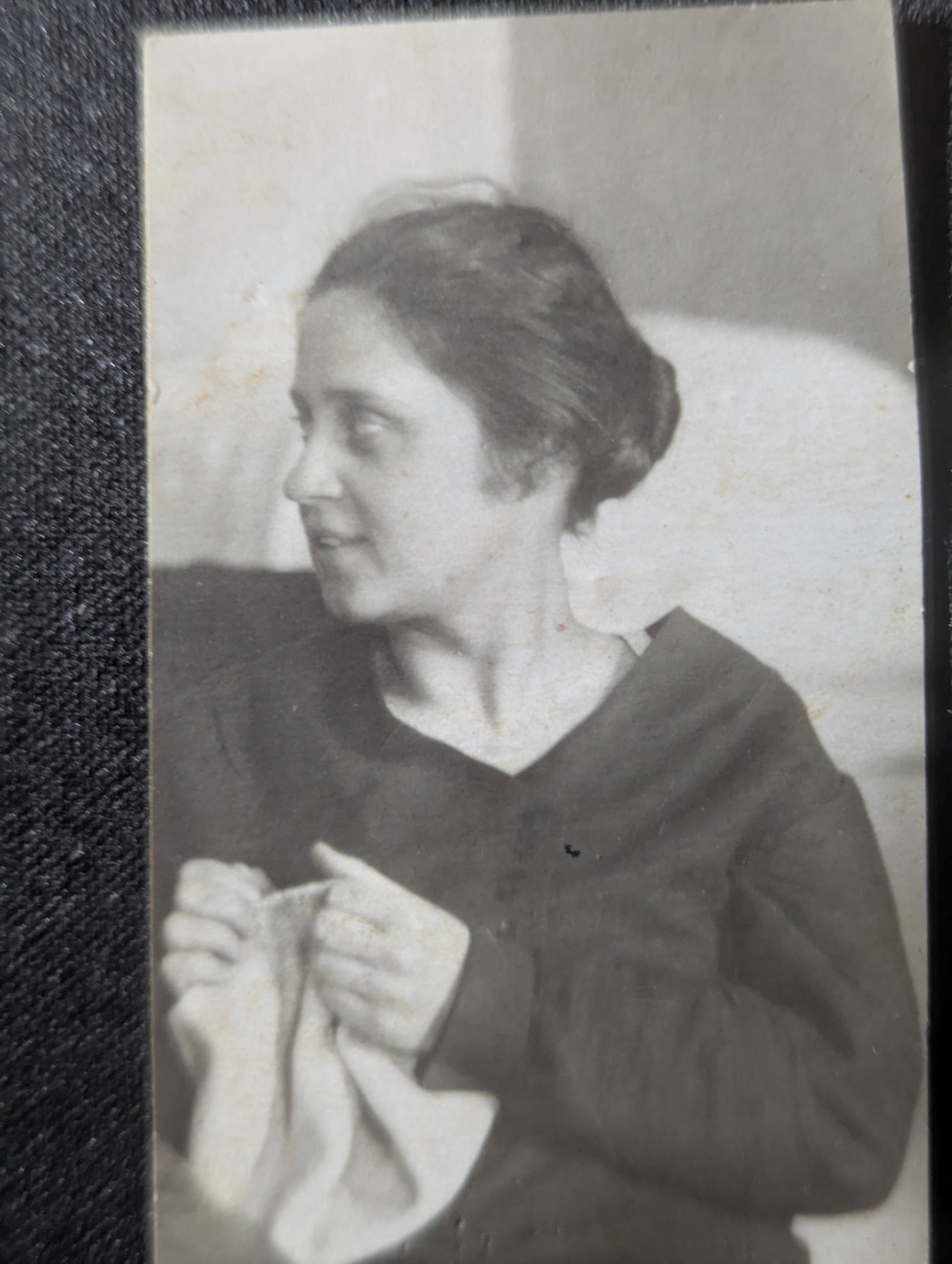
Anna Venidiktovna Voinova, undated family photograph.
A Life Shaped by Resilience
The scholarship is easier to understand alongside the life. Voinova lost her father to the Russo-Japanese War before she was old enough to remember him, came of age through revolution and civil war, and arrived in Moscow in 1921 with a gymnasium education, a facility at the piano, and very little else.
She built a career inside the Moscow Conservatory system through the 1930s, the war years, and the long grey decades that followed — teaching by day and, at a desk at home, assembling a dictionary that no institution had asked her for. The research was done in the margins of an already full working life, in longhand, on index cards, one citation at a time.
That she continued the campaign for publication into her late eighties, through two decades of deferrals, says as much about her as the classification system does. The archive is the record of a person who simply did not stop.
1900
Born, Mikhailovka, Simbirsk Province
1915
Gymnasium musical evening, Syzran
1921
Moves to Moscow
1962
Earliest theoretical manuscript
1967–1987
24-year publication campaign
1982
Article published in «Русский язык в школе»
1992
Anna Voinova passes away
2026
Archive digitized and offered for institutional placement
The Work
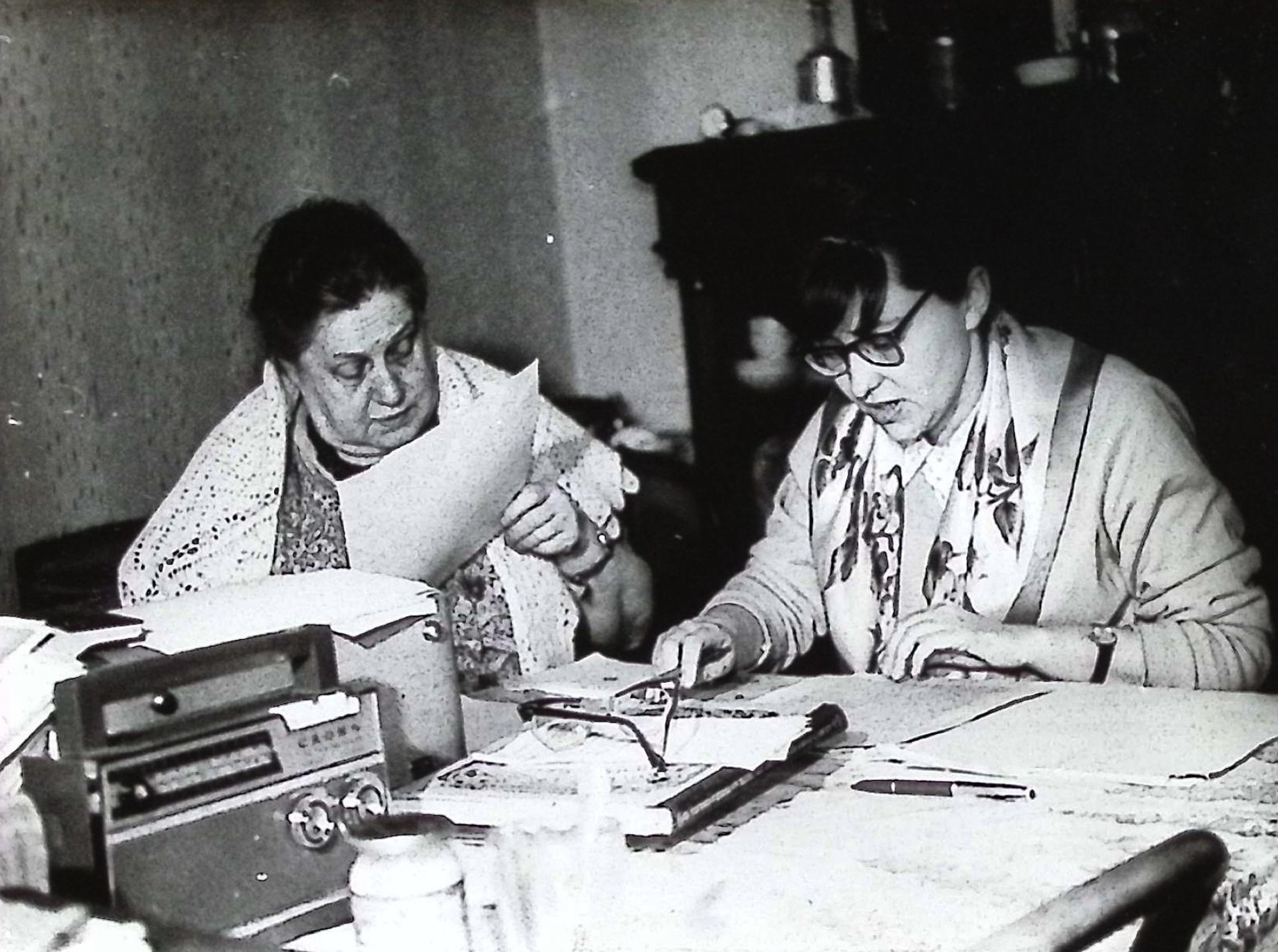
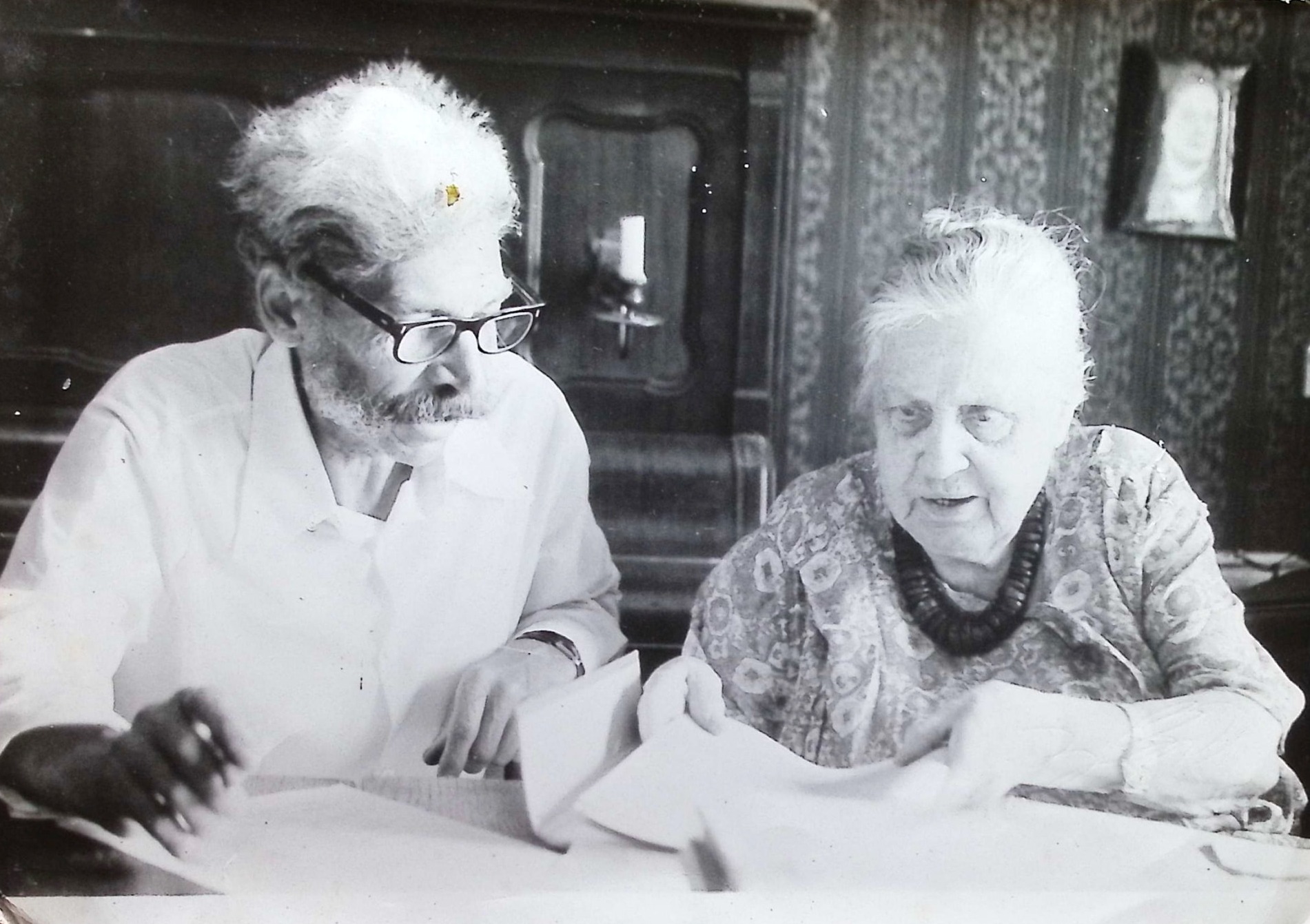
The dictionary was not written alone. These photographs show the ordinary machinery of it: proof sheets, an inkwell, colleagues and assistants reading over a shoulder, an afternoon that ran long.
Photographs are undated unless noted; identifications come from family recollection.
Voinova with an assistant, working through a set of sheets at the dining table.With a colleague, comparing entries.
Historical Archive
The scholarly research archive documents the dictionary project across eight related document series, from the raw lexical evidence through to finished, published articles.
Scope at a glance
Series
Description
Count / Scope
Digitized?
M
Principal manuscript: «Словарь одного и двух Н в русском языке», plus earlier theoretical drafts and the master lexical corpus
7 items, incl. 3 undigitized drafts
Partial
A
Scholarly articles — published and unpublished — on participle/adjective orthography and related topics
The research apparatus itself: lexical card envelopes with grammar and literary-citation cards — the raw evidence behind every dictionary entry
~1,000 envelopes total; ~65 headwords digitized so far
~20%
B
Biographical documents: employment records, character references, certificates and institutional testimonials, 1925–1972
3 items
Yes
METH
Methodological classification systems and statistical tables underlying the dictionary's structure
3 items
Yes
R / REF
Institutional commission minutes, official recommendations, an outside dissertation citing Voinova's work, and a master reference/abbreviation key
6 items
Yes
Note on digitization status: this is a snapshot of a collection still being processed. Over 30 binders and roughly 1,000 individual lexical card envelopes exist in total; a meaningful portion — mostly handwritten material — remains packed and has not yet been scanned. What is described here reflects the material digitized and catalogued to date, not the full physical holdings.
The current digitization workstation: original cards and binders being photographed page by page, preserving the archive's original order.
Highlights
A complete unpublished dictionary manuscript («Словарь одного и двух Н в русском языке»), with theoretical chapters, a full alphabetical word-list, and a master word-count summary putting the finished work at 4,619 word-forms across two parts.
A formally co-authored proposal to revise §§62–63 of the official 1956 Soviet orthographic code — not a personal reference work, but a submission aimed at changing the underlying rule.
Three confirmed print publications in «Русский язык в школе,» including the 1982 article distilling her core methodology.
A 24-year documented publication campaign: petitions to Goskomizdat, correspondence with multiple publishing houses, peer reviews (both supportive and critical), and an explicit paper trail showing the dictionary was repeatedly deferred because of a standing contract for a competing work — not on the merits of the work itself. (See “The Unresolved Question” near the top of this page — we looked into that competing title, and it turns out not to cover the same ground.)
Written endorsements connected to major Soviet cultural and linguistic figures, including a 1982 letter of support from the Union of Writers RSFSR signed by novelist Yuri Bondarev, and references throughout the correspondence to engagement with Viktor Vinogradov and A. A. Reformatsky.
The complete research apparatus behind the dictionary: roughly 1,000 individual lexical card envelopes (one per headword), each preserving a grammar/definition card and multiple literary citation cards with author, title, year, and page — a rare survival of the working evidence behind a major unpublished reference work, not just its conclusions.
Independent institutional validation: official commission minutes, ministry-level recommendations, and at least one outside doctoral dissertation (Osenmuk, 1979) citing Voinova's work — evidence the research had recognized standing within the field, beyond her own advocacy for it.
This Is Not Archaic
This archive is not a nostalgia object. It is a living corpus of Russian language research: thirty-five years of reading, thinking, typing, and belief, left unpublished not because it was finished, but because the country that would have published it ceased to exist.
Anna Voinova died in 1992. The Soviet Union collapsed the same year. Her dictionary, already in correspondence with publishers and already recommended by the Academy, simply had no floor beneath it anymore.
Her family kept the archive intact through emigration, moves, and decades because they saw what she had built. They knew the work was serious. They believed in her intelligence, her method, and her patience. Eighty-six catalogued items, thirty binders, roughly a thousand citation envelopes — all carried across an ocean and stored for forty years, waiting for the moment when someone else would understand what the family already knew.
Thirty-five years of reading, thinking, typing, and believing. Then forty years of keeping it safe.
Physical Collection
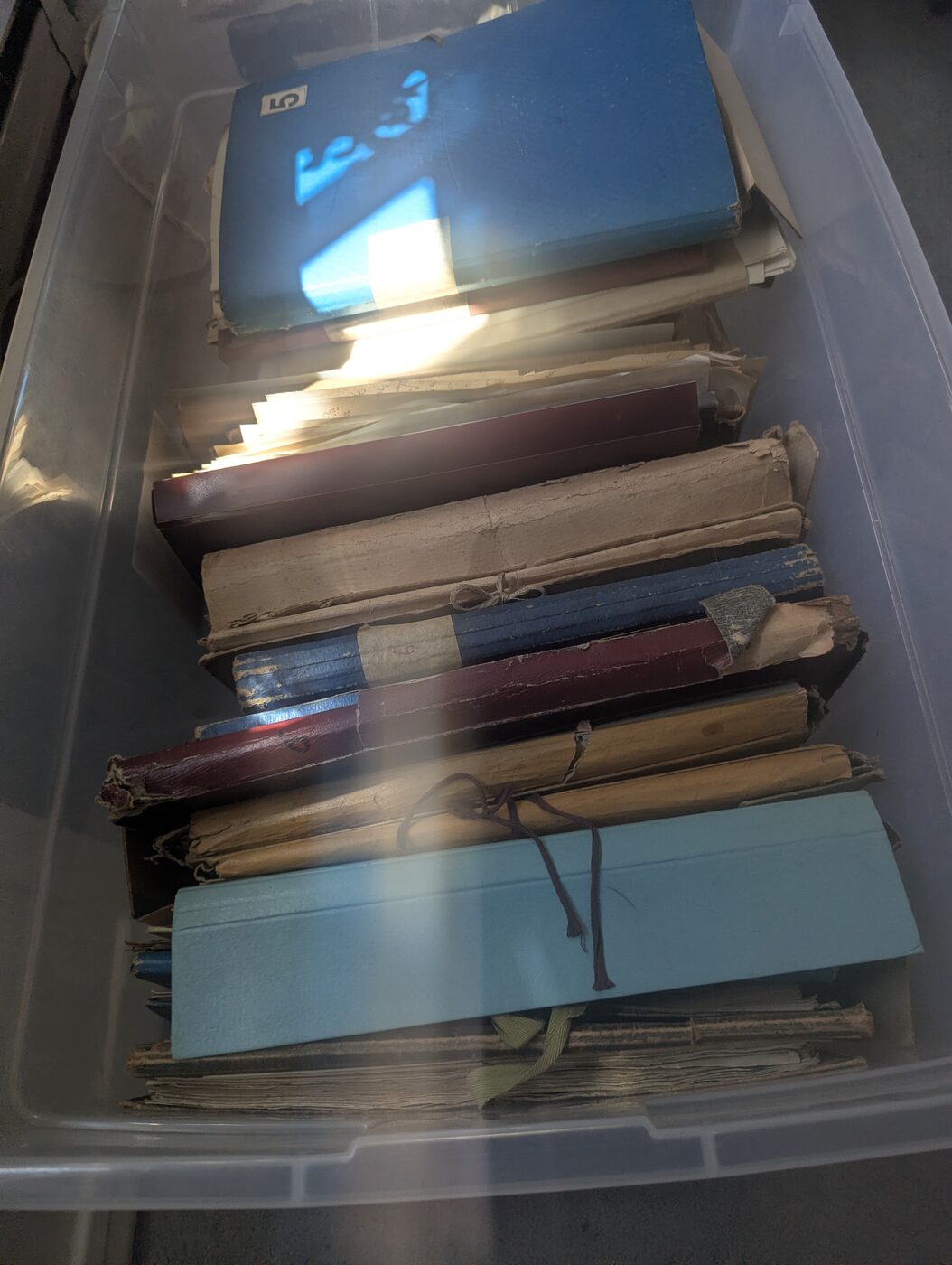
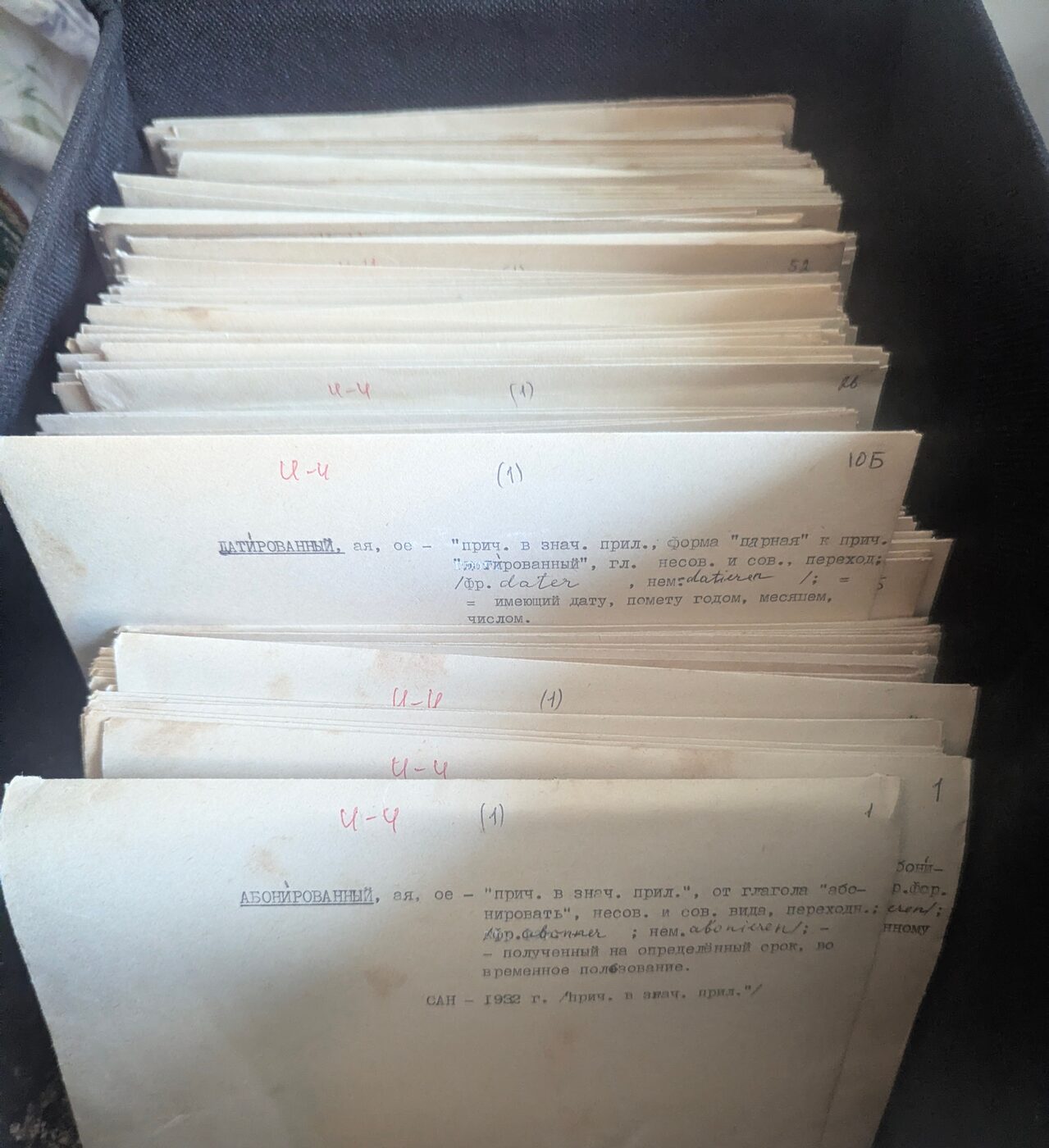
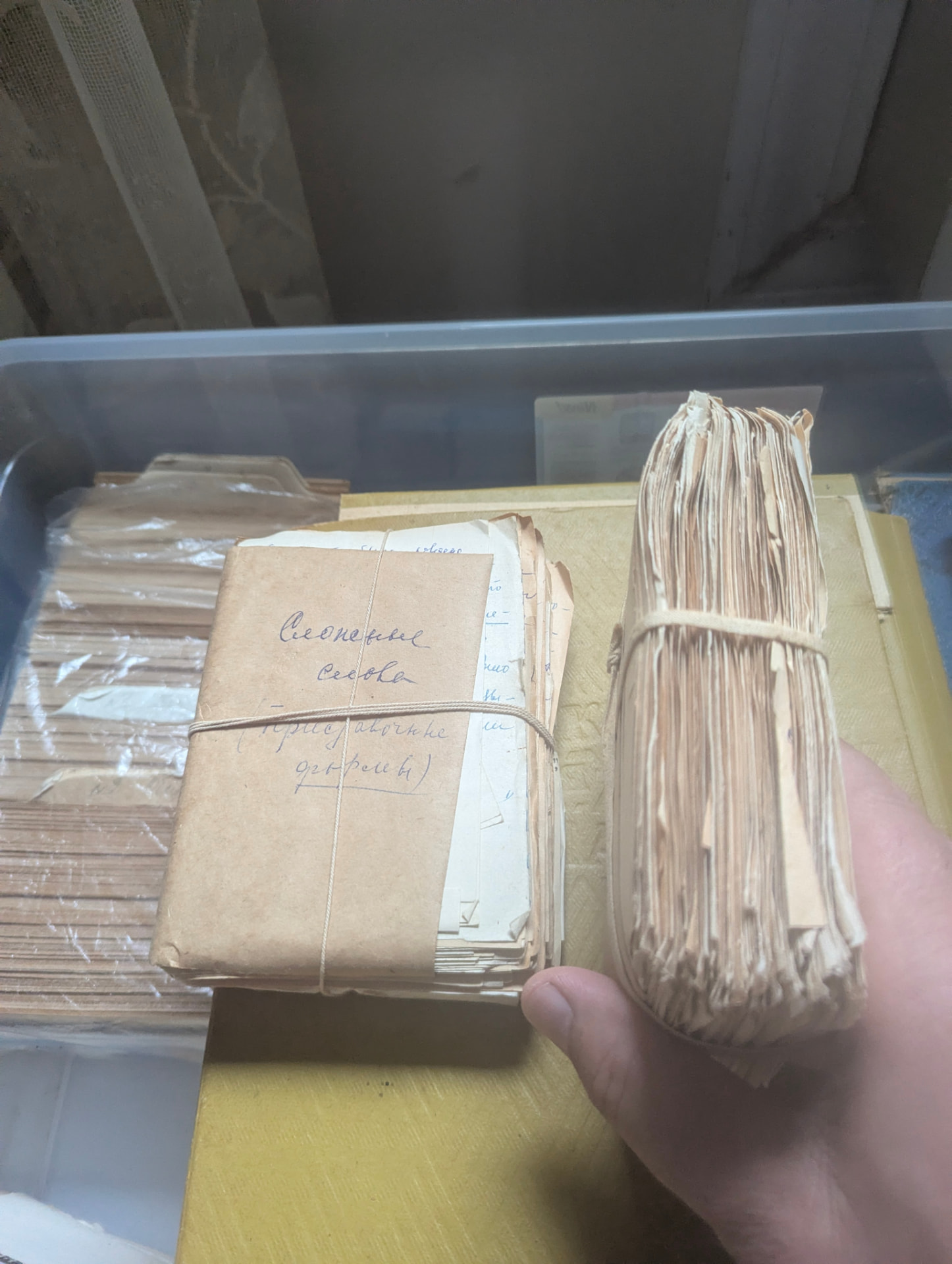
Before digitization, the collection exists as it has for decades: bound in string-tied cardboard folders and cloth-spine binders, organized by hand, and stored in stacked totes. The images below show the collection largely as it was found, prior to the current digitization effort, and are included to give a reviewer a sense of the physical scale and condition of the material.
One storage tote containing a portion of the bound research binders — hand-labeled spines, string ties, and decades of handling are visible. This is a fraction of the total 30+ binders in the collection.A card-catalog drawer from the lexical evidence archive, showing the density and organization of the underlying research material — this is the physical source for the digitized items in Series E.
These images illustrate why digitization has proceeded in stages: each binder and card group must be physically handled, photographed page by page or card by card, and then catalogued individually — a slow process for a collection of this scale, but one that preserves the material intact and in its original order throughout.
Sample Documents
A small selection from the collection, illustrating its range — from the research evidence itself, through the institutional record of the publication campaign, to proof of eventual print publication.
Proof of publication
Despite decades of rejection for the book-length dictionary, Voinova's core methodology did reach print. Below: the opening of «Суффиксы «нн» и «н» в причастиях и отпричастных прилагательных», «Русский язык в школе», no. 2, 1982, pp. 86–89.
Institutional endorsement
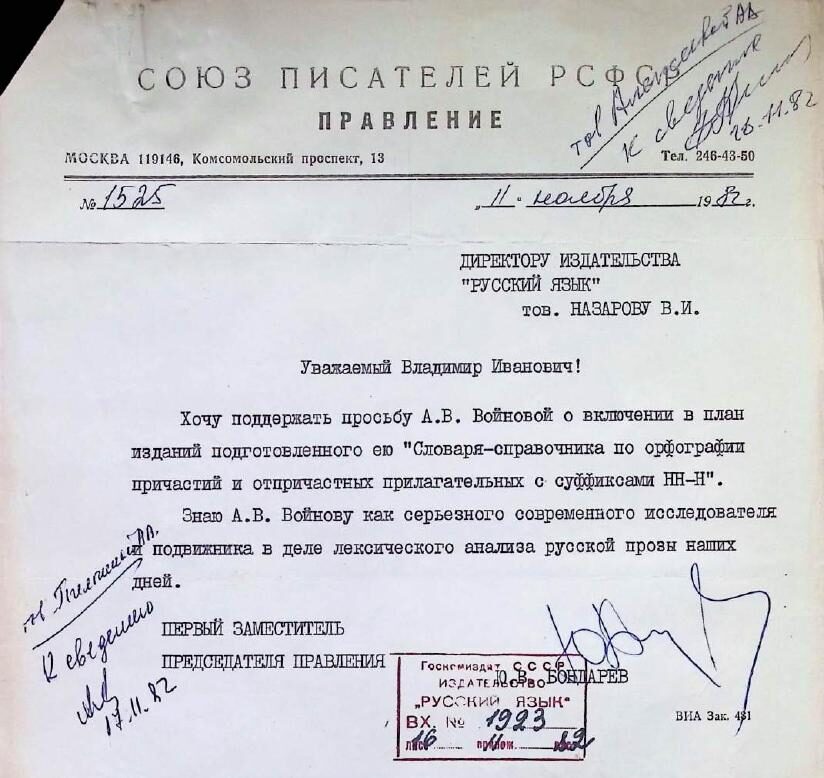
A 1982 letter to the director of the «Русский язык» publishing house from the Union of Writers of the RSFSR, signed by novelist Yuri Bondarev, formally supporting Voinova's application — one of several such endorsements in the correspondence archive.
The finished product, in miniature
A complete, publication-ready specimen dictionary entry for the word гранёный (“faceted/cut”), showing the full citation apparatus — dictionary-source codes and literary quotations from Pushkin, Paustovsky, and Yevtushenko — that each of the dictionary's roughly 4,600 word-forms would have carried.
The research apparatus
One card from the roughly 1,000-envelope lexical card corpus — the raw evidence-gathering process behind every dictionary entry, preserved essentially intact.
The master comparative ledger
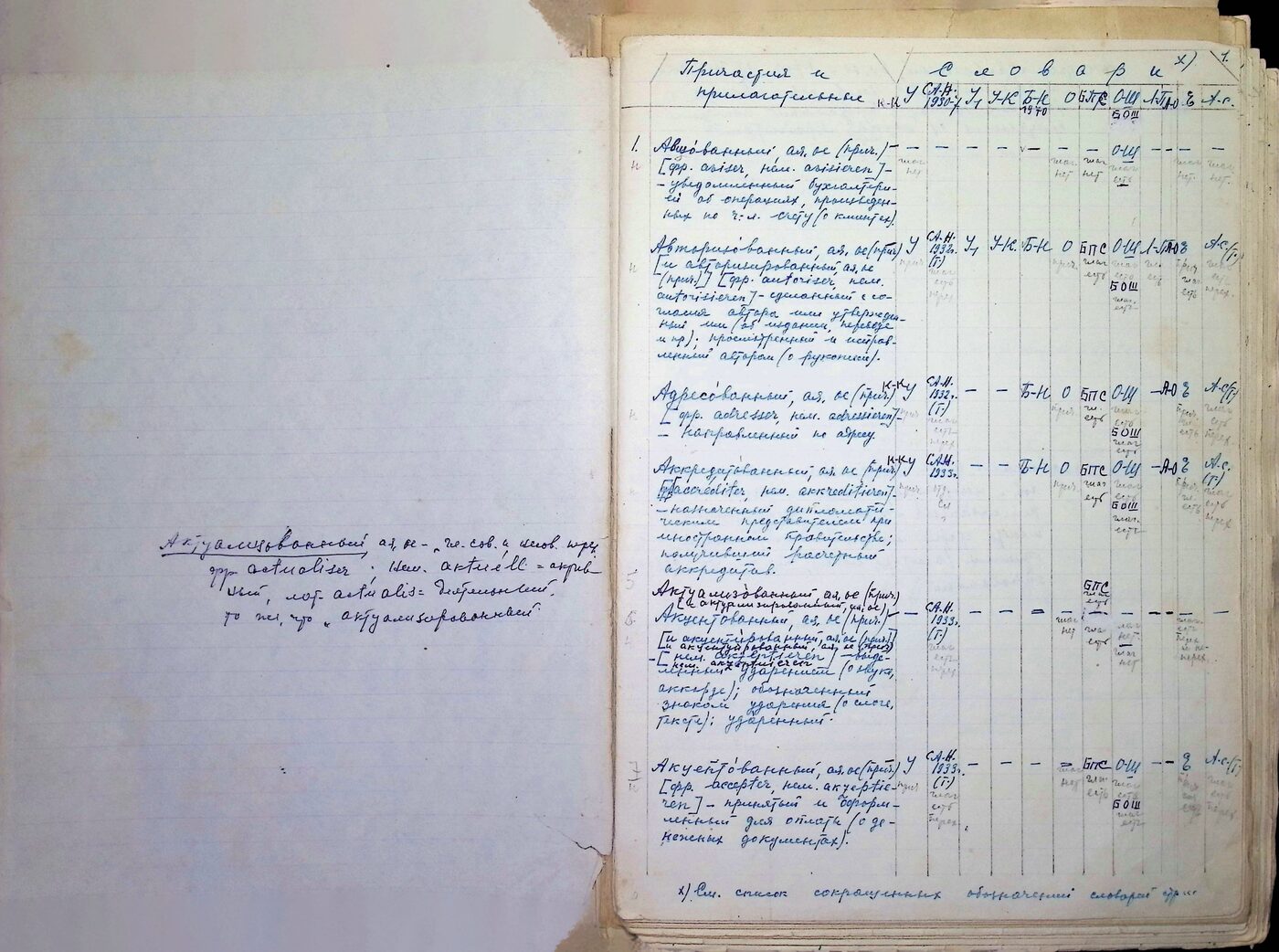
A page from the master comparative ledger — a handwritten working table cross-referencing participle and adjective forms across the alphabet, one of the largest single research documents in the archive.
The Structure of the Work
Every one of the roughly 4,600 word-forms was recorded in the same fixed set of fields. This is what makes the archive more than a pile of paper: it is a consistently classified linguistic database, built by hand, one envelope at a time.
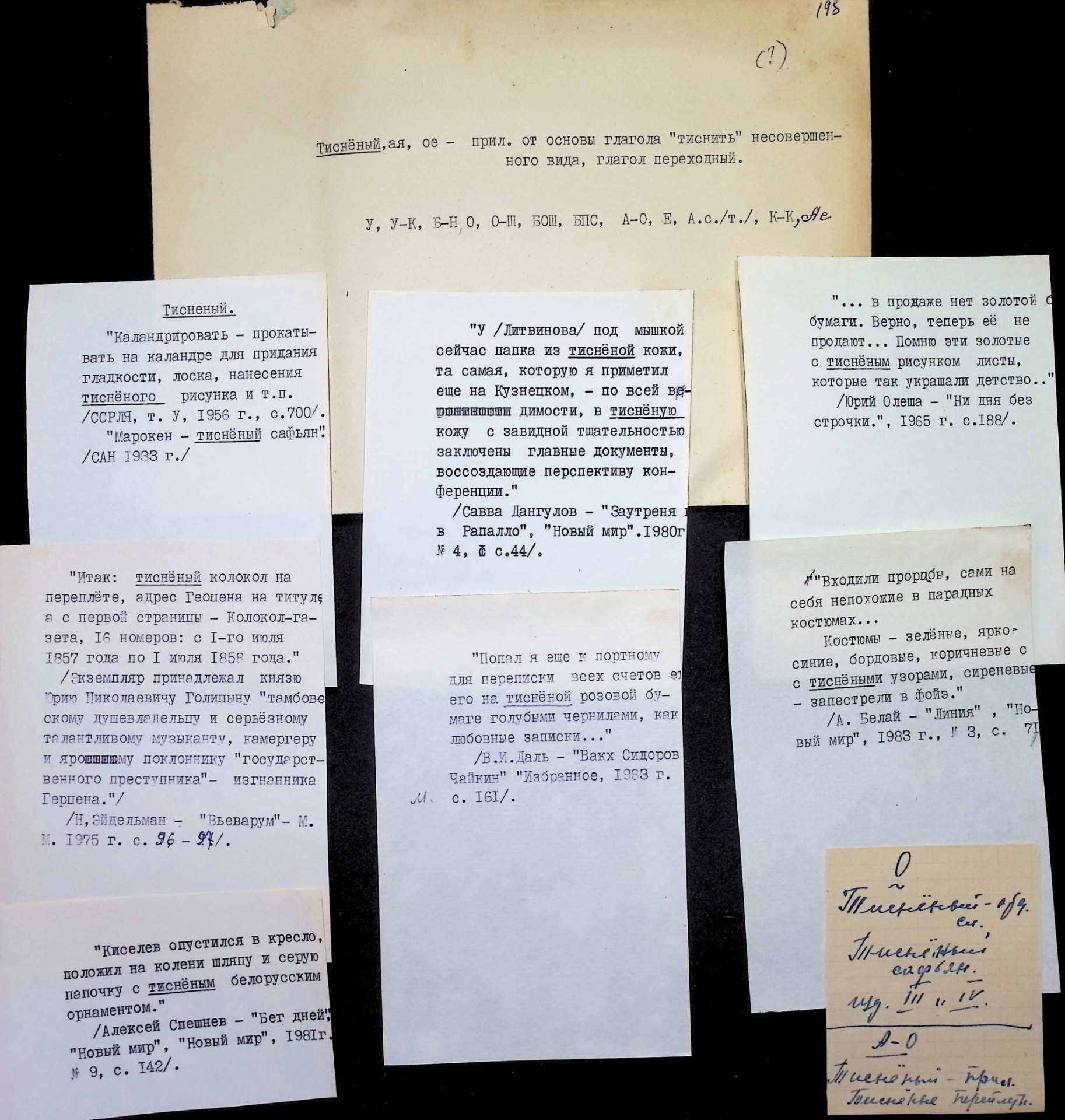
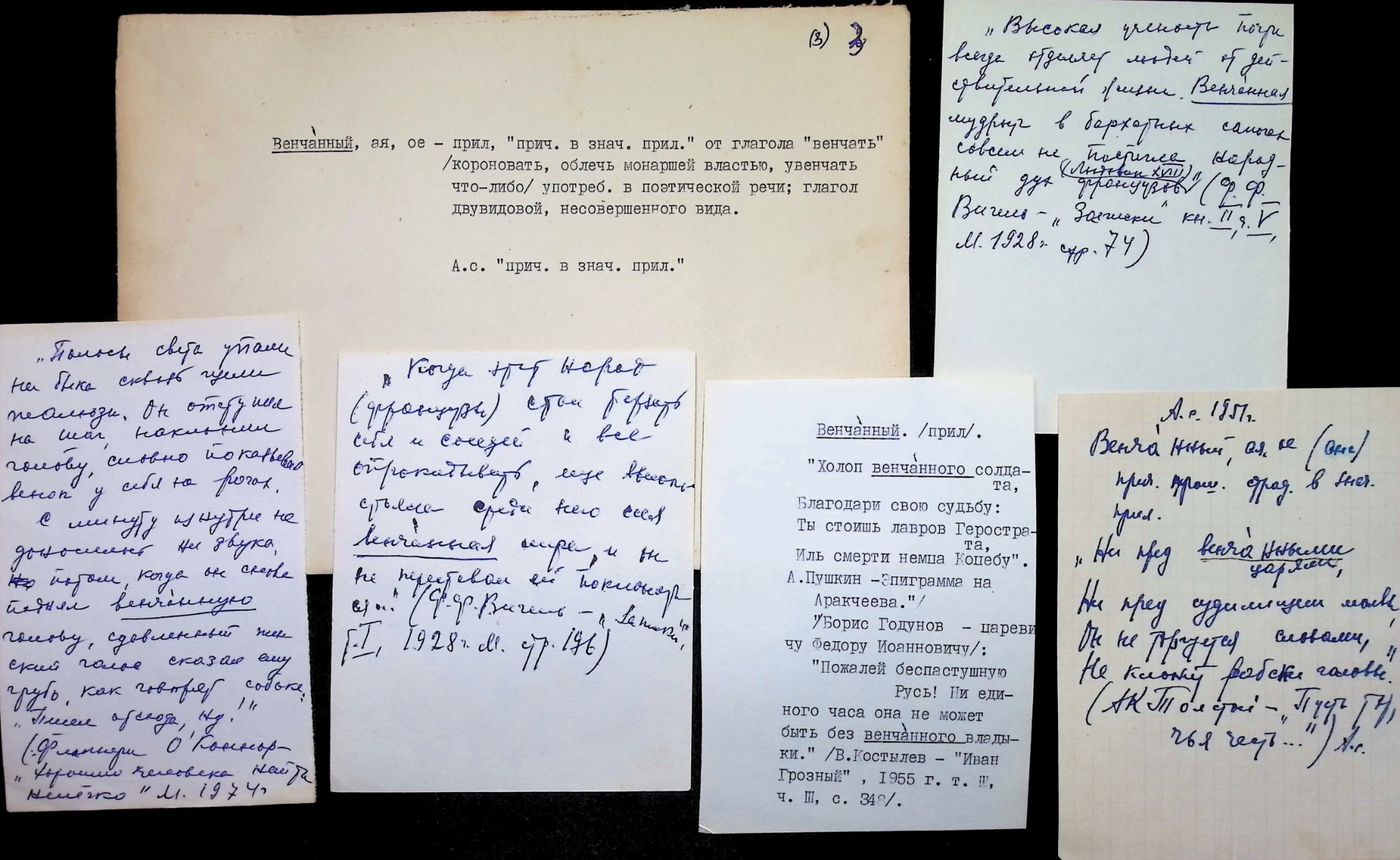
The photographs below show two entries from the archive — the words тиснёный and венчанный — each with its master card and the smaller citation cards that belong to the same envelope. The master card gives the headword, its grammatical class, and its source dictionary codes; the surrounding cards add attested usage and dated literary quotations. This is the level at which the whole project operated: every form is fixed, classified, and then supported by evidence.
One entry, one envelope: master card plus citation cards for тиснёный. The dictionary codes at the top of the master card tell which standard references record the form; the cards below give the literary proof.
A second entry, венчанный, photographed in the same arrangement. The layout is identical in shape: headword, classification, source codes, then handwritten and typed citation cards pulled from dictionaries and literature.
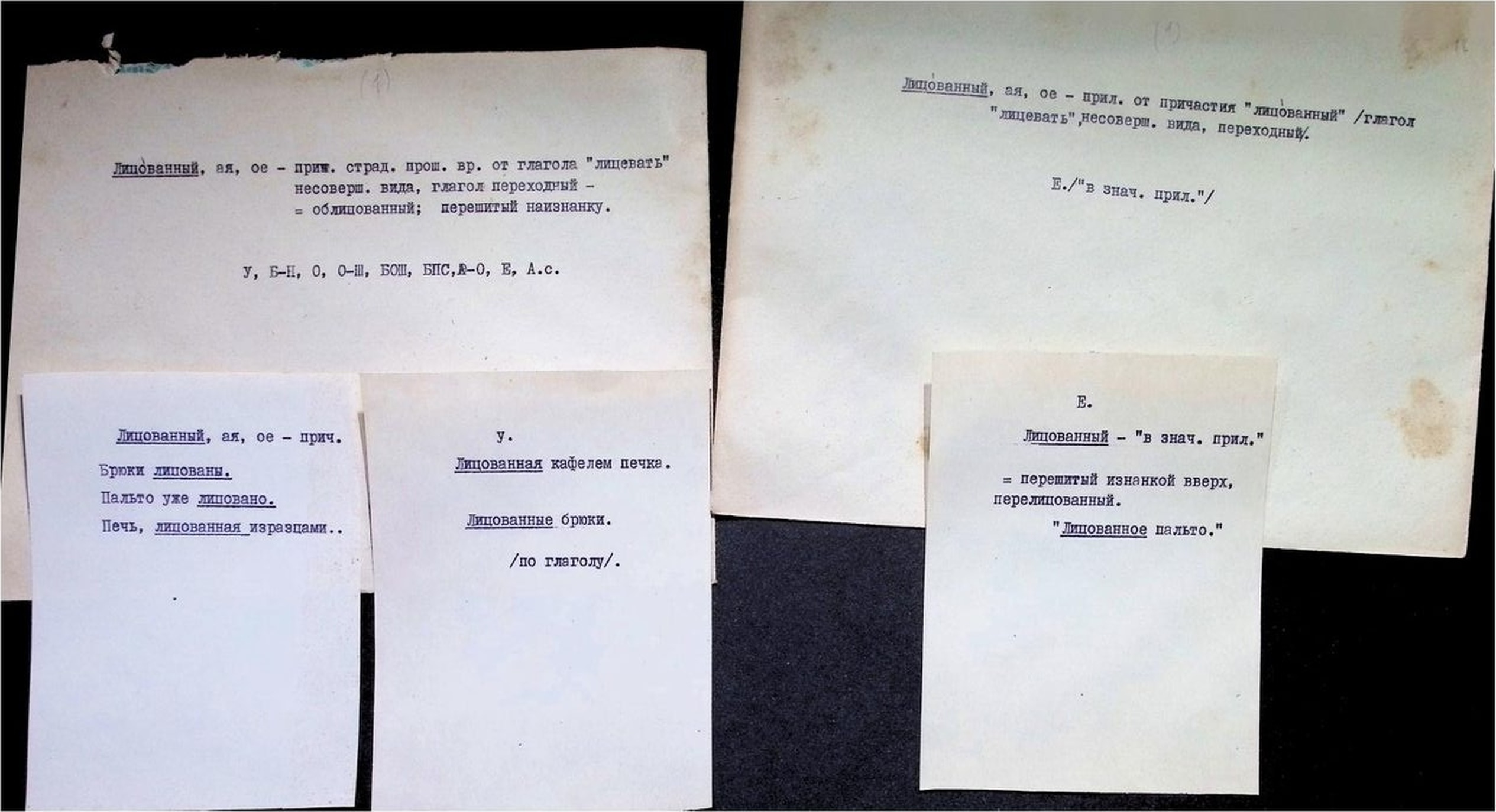
One envelope, one wordA word-envelope holds the master card and its usage cards together. Roughly a thousand of them survive, and the classification on each is identical in shape — which is precisely why the corpus can be digitized and queried today rather than merely admired.
01
Headword and inflection
Лицованный, ая, ое
The form as it enters the dictionary, with its gender endings.
02
Grammatical classification
прич. страд. прош. вр.
Passive past participle — the category that decides -н- or -нн-. Where a form functions as both participle and adjective, it is split into two separate cards.
03
Derivation and verb properties
от глагола «лицевать», несоверш. вида, глагол переходный
Source verb, aspect, transitivity — the three conditions Voinova's rule depends on.
04
Semantic gloss and synonyms
= облицованный; перешитый наизнанку
Meaning stated plainly, so that homonyms cannot be silently merged.
05
Source-dictionary codes
У, У-К, Б-Н, О, О-Ш, БОШ, БПС, А-О, Е, А.с.
Every authority that records the form — Ushakov, Ozhegov, Ozhegov–Shvedova and the rest. Absences are as informative as entries: a code missing here marks a form the standard dictionaries never settled.
06
Attested usage
Брюки лицованы. Пальто уже лицовано. Лицованная кафелем печка.
Short usage cards kept in the same envelope, separating verbal use from adjectival use.
07
Literary citation
Pushkin, Paustovsky, Yevtushenko, Prokofiev…
Where the finished entry required proof, a dated quotation with full bibliographic reference was typed out in full.
Scale of the sampling
The corpus behind the dictionary contains roughly 1,000 individual envelopes — one for each headword — and supports a finished word-list of 4,619 forms. Some envelopes are almost entirely typed, with neat master cards and machine-typed quotations; others, especially the older batches, are still in Voinova's handwriting and have not yet been scanned.
The two card groups you see above — тиснёный and венчанный — are exactly the kind of material that remains: partly handwritten, partly typed, and ready to be digitized with the same high-speed scanner already used for the rest of the archive. It is not a small residue — it is a large, still-untapped body of evidence that would complete the published dictionary's footnotes.
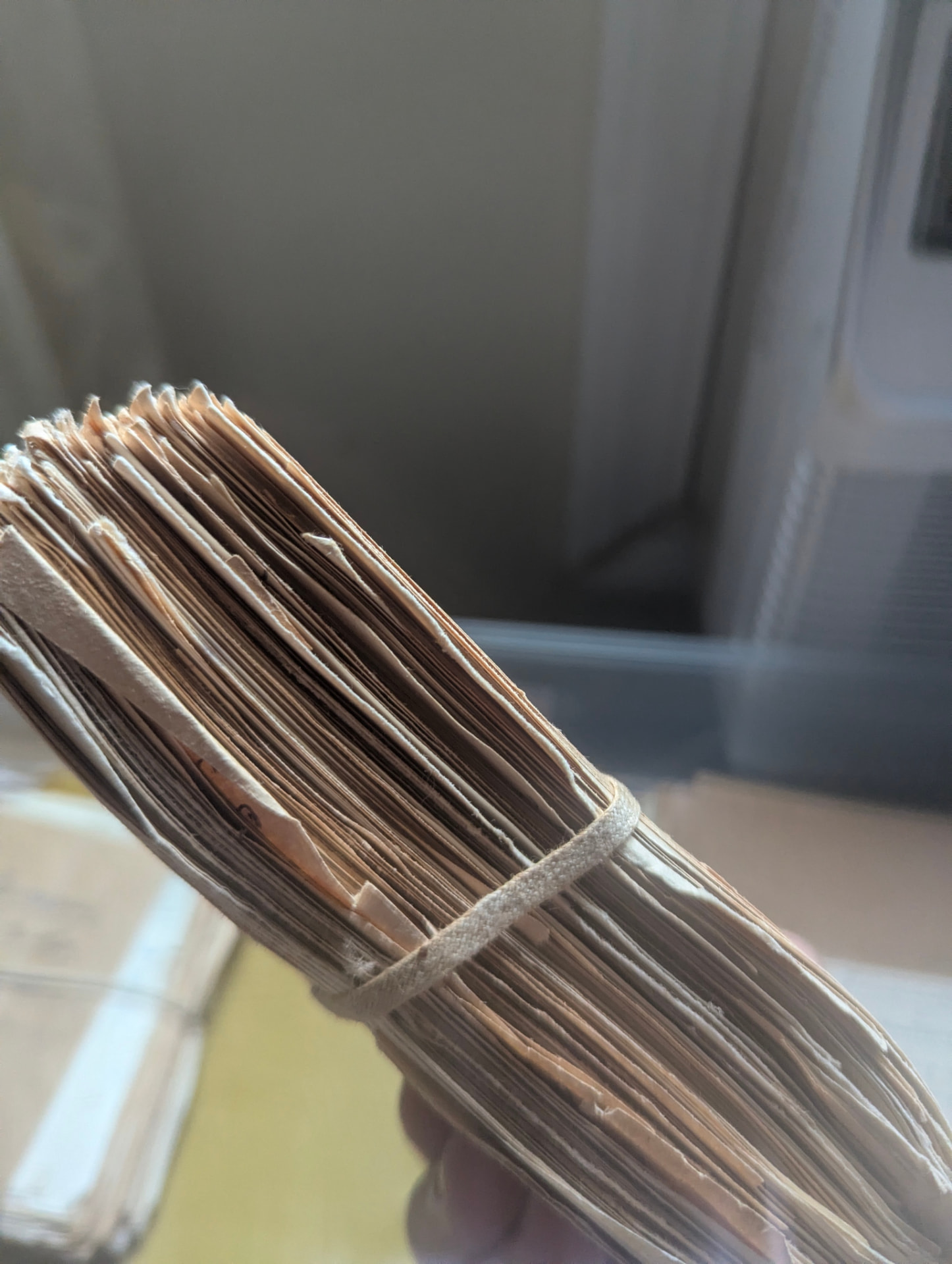
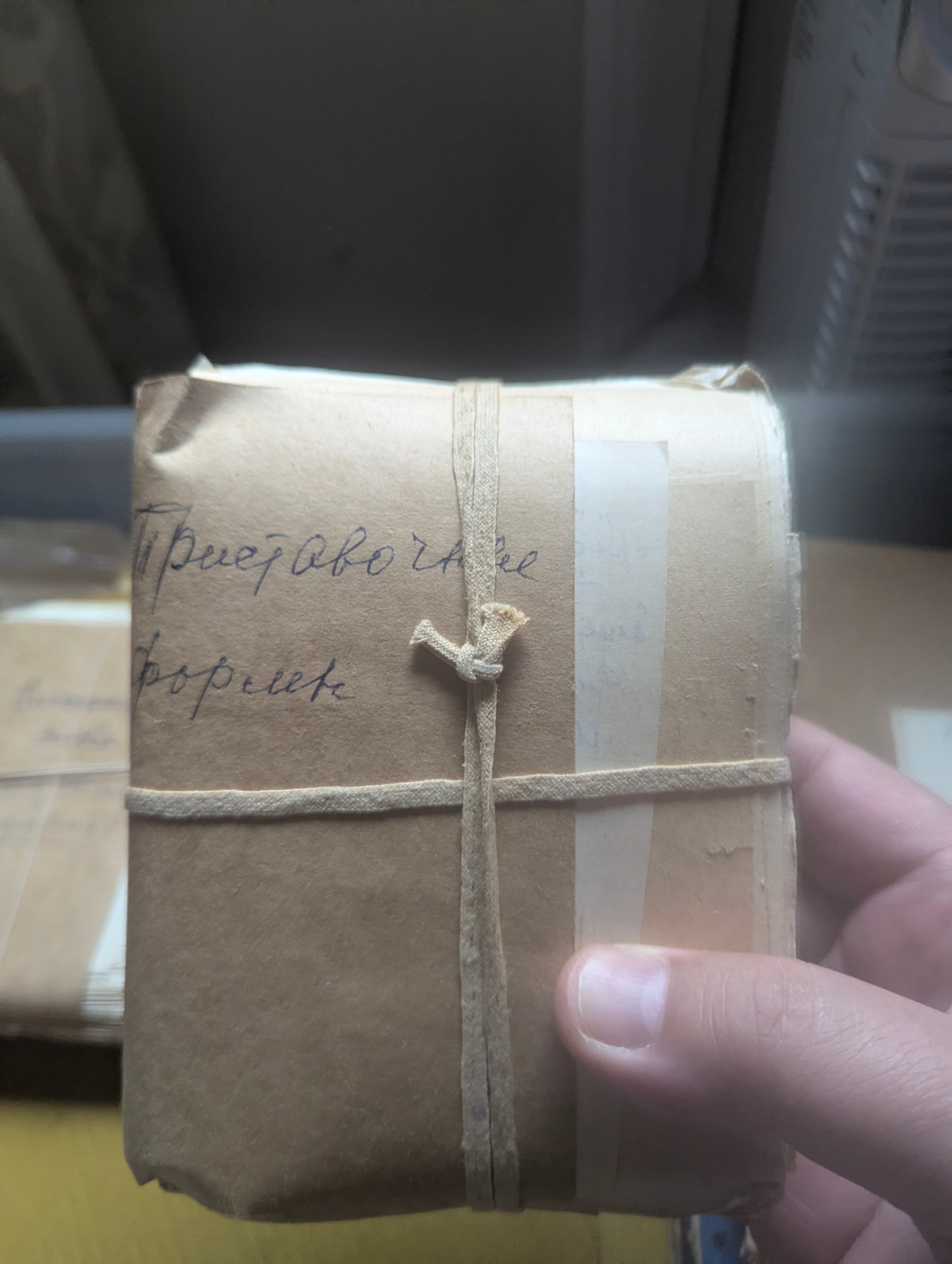
A significant part of the material, however, has never been processed properly. Bundles remain tied exactly as they were left: sorted by word, but not collated, not indexed, not checked against the finished word-list. The family preserved everything with great care — nothing was thrown away, nothing was reordered on a whim — but preservation is not classification. Completing the structural integrity of the work now requires an organised, systematic pass by a researcher: opening each bundle, verifying the fields, and bringing the handwritten cards into the same digital form as the typed ones.
Untied but unprocessed: a bundle of cards still bound in cotton tape, as it was left.One word, one packet — a hand-labelled envelope, sealed since the 1980s.Sorted and stored by the family, but awaiting systematic collation and digitisation.
This is Voinova's central contribution: not merely a spelling rule, but a fully evidenced, consistently classified linguistic corpus. Headword, category, derivation, meaning, attestation, evidence — the same six questions applied to the hardest corner of Russian spelling for thirty-five years. That architecture is what makes the archive publishable, verifiable, and usable today.
The Core Article
Of everything in the collection, the single document that best explains Voinova's whole research programme in her own words — the “bird's-eye view” of the Н/НН problem — is the 1982 published article: «Суффиксы «нн» и «н» в причастиях и отпричастных прилагательных» (“The Suffixes -нн- and -н- in Participles and Deverbal Adjectives”), Русский язык в школе, № 2, 1982, pp. 86–89 [archive ID A-016]. It is the only place in the archive where Voinova lays out, start to finish and in print, the full classification framework — semantic, syntactic, genetic, morphemic, aspectual, phonetic, and orthographic criteria — that everything else in the collection (the lexical cards, the numbered word-lists, the dictionary manuscript itself) was built to support.
What follows is a transcription of the article as printed, prepared directly from the page scans. It runs to nearly the full four printed pages. A small number of individual example words in dense passages carry minor transcription uncertainty given the age and photographic quality of the source; the original scans are retained and available for verification against any published or reprinted version of the text.
Original text (Russian)
СУФФИКСЫ «НН» И «Н» В ПРИЧАСТИЯХ И ОТПРИЧАСТНЫХ ПРИЛАГАТЕЛЬНЫХ
Войнова А. В., Москва — Русский язык в школе, № 2, 1982, с. 86—89
The transcription above covers the article's opening statement of the problem, its full six-part classification framework (semantic, syntactic, genetic, morphemic, aspectual, orthoepic, and orthographic criteria), its worked examples, and its key quantitative finding — that “paired” participle/adjective forms (257 pairs, 514 words) outnumber “unpaired” single forms (173) in the corpus she built from Ushakov's dictionary onward. The final page of the printed article (p. 90) continues into the unpaired-forms count and a summary table; both are preserved in the original scan.
Masculine Prose
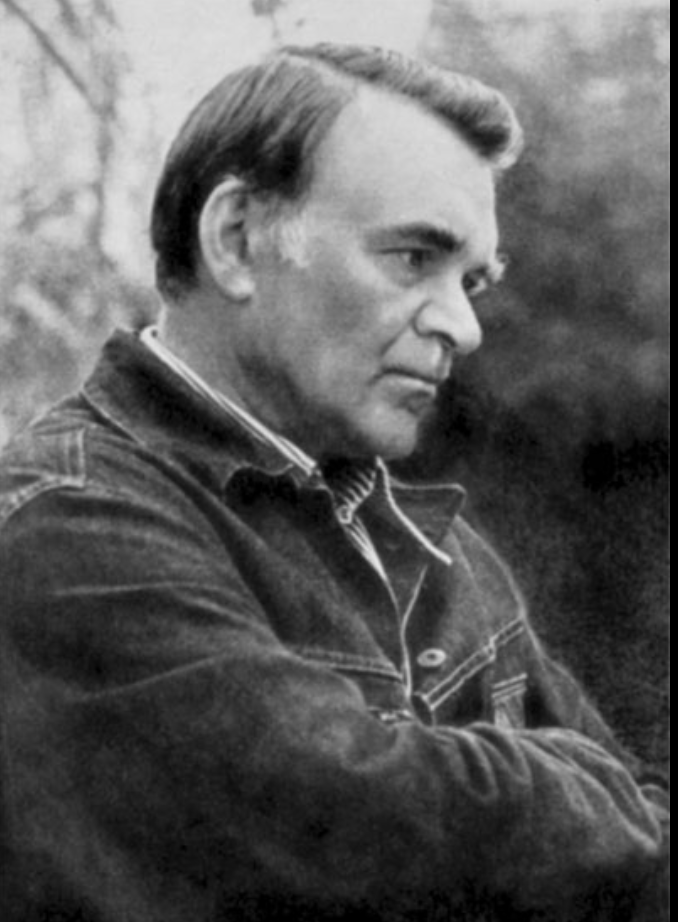
Yuri Bondarev was not a linguist. He was a Soviet novelist and war writer — one of the best-known prose writers of his generation, a man whose sentences were famously muscular, weighed down by what critics called “мужественная проза,” masculine prose.
Family memory, not supported by a document in the archive, says that Voinova once spoke to him about this phrase directly. She told him, in her own reading, that his prose was "мужественная проза" — and that it struck him with an indelible effect. She was speaking as a reader and a linguist, not as a critic. She saw that his sentences were built from the very verbal adjectives and participles she had spent her life mapping: the words where Russian still hesitates between one Н and two НН.
That personal exchange, true or only half-remembered, is exactly what makes the 1982 letter matter. It is not simply an institutional endorsement. It is a writer who cared about the texture of his own language recognizing a woman who had spent thirty years preserving that texture from the inside.
Yuri Bondarev (1924–2020), novelist and signatory of the 1982 letter.Union of Writers of the RSFSR, letter of support, 11 November 1982, signed Yu. Bondarev.
I wish to support A. V. Voinova's request that the “Dictionary-Reference of the Orthography of Participles and Deverbal Adjectives with the Suffixes НН–Н”, which she has prepared, be included in the publishing plan. I know A. V. Voinova as a serious contemporary researcher and a devoted worker in the lexical analysis of the Russian prose of our day.
Yuri Bondarev, First Deputy Chairman of the Board, Union of Writers of the RSFSR
Letter no. 1525, 11 November 1982; received by the publisher 16 November 1982 (incoming stamp no. 1923).
Original text (Russian)
Хочу поддержать просьбу А. В. Войновой о включении в план изданий подготовленного ею «Словаря-справочника по орфографии причастий и отпричастных прилагательных с суффиксами НН–Н». Знаю А. В. Войнову как серьезного современного исследователя и подвижника в деле лексического анализа русской прозы наших дней.
Voinova was not inventing a problem. She was documenting a problem that writers themselves lived with every time they sat down to write.
The family kept this archive for more than four decades not because it was a curiosity, but because they saw and knew its importance. They understood that a language is preserved not only by the people who write in it, but also by the linguists who quietly refuse to let it become sloppy. Voinova was one of those linguists. Bondarev, in his own way, recognized it.
Full Collection Inventory
The list below covers every digitized and catalogued item in the scholarly archive to date, organized by series, with the working title (or, where no formal title survives, a descriptive title assigned during cataloguing) and approximate date. This inventory reflects material digitized and catalogued as of August 2026; it does not include the roughly 800 remaining lexical card envelopes or additional binders still awaiting digitization. A live, cross-linked version of this catalogue — with full metadata, scans, and relationship mapping between items — is maintained in a structured digital archive and can be shared or exported on request.
Full digitized archive on Google Drive — coming soon
86 items
ID
Title
Description
Date
Scan
A-001
Orthography Reform and the Problem of Н / НН
This article analyses the proposed Soviet orthographic reform and its consequences for the spelling of one and two Н in Russian adjectives and participles. Voinova argues that the proposed simplifications would…
undated
A-002
Methodology for the Dictionary
Explains the research methodology used to construct the lexical corpus supporting the future dictionary. Describes classification principles, source selection and grammatical analysis.
undated
A-003
Compound Adjectives with a Participial Second Component
Technical linguistic analysis examining the spelling of one and two Н in compound adjectives containing participial second elements.
undated
A-004
Literary Evidence Supporting the Dictionary
Collects literary examples demonstrating authentic usage of one and two Н in Russian texts.
undated
A-005
Compound Adjectives (Title Page / Duplicate)
Currently catalogued as a provisional document until its relationship with A-003 has been confirmed.
undated
A-006
Participles and Adjectival Forms Ending in Н / НН
Examines the semantic distinction between participles and adjectival forms ending in one and two Н. Includes an accompanying scholarly review recommending publication after revision.
undated
A-007
Orthographic Proposals for the Spelling of НН / Н in Verbal-Nominal Forms
Comprehensive analysis of Soviet orthographic reform proposals concerning the spelling of one and two Н in participles and adjectival forms. The paper reviews discussions from 1956–1966, evaluates competing orthographic…
undated
A-008
Причастия и отпричастные прилагательные, их различение и правописание
This unpublished research article presents one of Anna Voinova's earliest theoretical studies on the orthography of Russian participles and participial adjectives. It argues that participles and adjectives form a…
1962
A-009
Not Simplification, but Complication
1965
A-010
Annotated Drafts of 'On the Spelling of the Suffixes Н/НН in Compound Adjectives'
1964–1965
A-011
Proposal for a Dictionary-Reference Book on the Orthography of Participles and Participial Adjectives
1967-07-05
A-012
Response to the Orthographic Commission on the Spelling of Н and НН
1966–1967
A-013
Theoretical Foundations of Participle Orthography
c. 1966–1967
A-014
Предложения по усовершенствованию орфографии глагольно-именных форм с суффиксами НН–Н
c. 1964–1966
A-015
Proposed Amendments to the Orthographic Rules for Verbal–Nominal Forms with the Suffixes Н–НН
1964–1965 (estimated)
A-016
Суффиксы -нн- и -н- в причастиях и отпричастных прилагательных (PUBLISHED)
1982-03 (issue: март-апрель, № 2, 1982)
A-017
О правописании лексикализованных сочетаний типа «штопаный-перештопанный» (PUBLISHED)
Likely 1986 (issue: № 3, 1986 — cover confirmed elsewhere in this batch)
A-018
К изучению правописания сложных и составных числительных (PUBLISHED)
Exact issue/year not identified — the pages sampled didn't include a masthead. If it matters, worth checking against the covers found elsewhere in this batch (issues spotted: 1930 "Учпедгиз," № 2 1982, № 3 1986, and one…
Unconfirmed — not the same topic or era as her НН/Н work
B-001
Professional Character Reference (Характеристика) for Anna Venidiktovna Voinova
Official professional reference describing Anna Venidiktovna Voinova's long teaching career, scholarly qualifications, methodological work, publications, educational philosophy, and professional reputation. The document…
Circa 1960s (exact year not specified)
B-002
Personnel Record of Anna Venidiktovna Voinova
Personnel record containing autobiographical information about Anna Venidiktovna Voinova. The document records her date and place of birth, family background, education, early teaching career, musical training, move to…
Unknown (circa 1960s–1970s)
B-003
Collection of Professional Certificates and Institutional Testimonials
The documents originate from multiple institutions and organizations between the 1920s and the early 1970s. They have been preserved together as a biographical reference file documenting Voinova's professional…
1925–1972
C-001
Memorandum to Vladimir Ivanovich Concerning the History of the Dictionary Project
A detailed memorandum addressed to Vladimir Ivanovich describing the history of the dictionary project from its beginning in 1966 through numerous unsuccessful publication attempts. Voinova recounts her participation in…
undated
C-002
Letter to Vladimir Ivanovich Concerning Publication of the Dictionary
A four-page letter addressed to Vladimir Ivanovich describing the history, structure, methodology, and scholarly significance of Voinova's dictionary of one and two Н. The author explains previous publication attempts,…
10 April 1987
C-003
Letter Requesting Assistance with Publication of the Orthographic Dictionary
The scanned copy includes attached handwritten routing and editorial notes that appear to have been added after the original letter was prepared. These annotations are preserved as part of the archival record.
1986-05-24
C-004
Petition to the Chairman of Goskomizdat USSR for Publication of the Orthographic Dictionary
The letter contains quantitative information on the planned dictionary, references endorsements from academic authorities including V. V. Vinogradov and I. F. Protchenko, and records several unsuccessful attempts to…
1986-03-09
C-005
1982 Proposal Letter to 'Russkiy Yazyk' Publishing House (to Vladimir Ivanovich)
1982-12-06
C-006
Editorial Rejection and Peer Review of Article Submitted to "Russian Language at School"
The file preserves both the official editorial response and the complete referee's report, providing a rare record of the publication and review process within Soviet academic publishing.
1967-12-19
C-007
Correspondence Batch — The Dictionary Publication Campaign, 1964-1988
1964/1966-1988 (multiple documents)
C-008
Correspondence & Personal Petitions Batch 2, 1950-1987
1950-1987 (multiple documents)
D-001
List No. 1 – Paired Forms
c. 1965–1980
D-002
Dictionary Entry Drafts (Copied Typescripts)
c. 1980–1982
D-003
Working Binder for List No. 1
c. 1980–1982
D-004
Early Research Binder No. 1
c. 1930s–1960s
D-006
List No. 2 – Non-Prefixed Participles and Related Adjectival Forms
c. 1964–1967
D-007
List No. 3 – Deverbal Adjectives with Single Н (Without Parallel Participial Forms)
c. 1964–1967
D-008
Early Working Binder for the 220 Paired Forms Project
c. 1962–1965
D-009
Publishing Proposal for the Orthographic Dictionary
Prepared as a complete submission package for editorial review by the publishing house "Russian Language". The document includes a detailed explanation of the dictionary's organization, theoretical foundations, and…
1986-07-24
D-010
Publishing Proposal for the Orthographic Dictionary (Expanded Proposal)
1982-12-06
D-011
Official Endorsement of the Orthographic Dictionary Project
The document is an official extract from the commission's meeting minutes (Protocol No. 11, 30 June 1972). It records discussion by several commission members and concludes with a formal resolution recommending the…
1972-06-30
D-012
Scholarly Review of Voinova's Article on the Spelling of -Н- and -НН- Suffixes
Signed by E. V. Samosyuk, Head of the Department of Russian Language at the Novosibirsk State Pedagogical Institute. The document is marked "Копия" (Copy), indicating it is a retained copy of the original review.
1981
D-013
Editorial Rejection and Peer Review of Article Submitted to "Russian Language at School"
The file preserves both the official editorial response and the complete referee's report, providing a rare record of the publication and review process within Soviet academic publishing.
1967-12-19
D-014
Editorial Rejection and Peer Review of Article Submitted to "Russian Language at School"
The file preserves both the official editorial response and the complete referee's report, providing a rare record of the publication and review process within Soviet academic publishing.
1967-12-19
D-015
Scholarly Review Recommending Publication of Voinova's Article
Unknown (circa early 1980s)
D-016
Scholarly Review, Editorial Notes, and Supporting Documentation for the 1982 Article
Although the documents originate from different sources, they all relate to the preparation, evaluation, and publication of Voinova's 1982 research on the orthography of participles and participial adjectives and have…
1982
D-017
Compound Verbal-Nominal Forms with the НН/Н Alternation in the Second Component
1965
D-018
List No. 4 — Table of Contents: Participles and Adjectives Ending in -ованный / -еванный
c. 1964–1967
D-019
Master Table of Compound Words with НН/Н in the Second Component (Prefixed and Non-Prefixed) — 328 Entries
Theoretical Essay — Distinguishing Participle from Adjective Forms; Compound-Word Inventory
Not yet cross-checked page-by-page against M-001's existing digitized chapter for overlap or continuity. Given the first-person voice and citation-heavy methodological style, this may be an earlier or alternate draft of…
Undated
D-038
Предложения по усовершенствованию орфографии — Proposal to Revise §§62-63 of the 1956 Свод (co-authored with D.F. Ivanova)
Undated (references the 1956 Свод orthographic code)
D-039
Specimen Dictionary Entries and Citation Cards
Undated
E-001
Working Index of Dictionary Envelopes and Word Cards
Unknown
E-002
Lexical Card Samples from 2026_07_27_17_53_00 Scan Session
Undated (individual dictionary entry cards)
E-003
Lexical Card Corpus — '-ованный' Causative Family (Batch 1)
Undated (individual dictionary entry cards)
M-000
Participles and Deverbal Adjectives: Their Distinction and Orthography
This manuscript is the earliest known comprehensive theoretical work in the Voinova Archive and represents the intellectual foundation of Anna Voinova's lifelong research programme on the orthography of Russian…
1962
M-001
Dictionary of One and Two Н in Russian
The principal unpublished manuscript representing more than three decades of linguistic research into the spelling and grammatical function of one and two Н in Russian. It synthesises Voinova's published work into a…
undated
M-002
Proposal for the Dictionary-Reference Book on the Orthography of Verbal-Nominal Forms with Н / НН
A comprehensive proposal describing the conception and methodology of Voinova's planned dictionary-reference book on the spelling of one and two Н in participial and adjectival forms. The document explains the…
6 December 1982
M-003
Participles and Participial Adjectives
1962
M-004
Structural Plan for the Orthographic Dictionary
This document functions as a project blueprint rather than a draft of dictionary entries. The numerous handwritten numerical revisions indicate that it remained an active planning document throughout the development of…
Unknown (circa late 1970s–early 1980s)
M-005
Master Lexical Corpus — ~220 Comparative Dictionary Entries
c. 1964–1967
M-006
Superseded Entry — see D-017
1965
METH-001
Master Classification of Verbal-Nominal Forms
c. 1964–1967
METH-002
Statistical Classification Tables for the Dictionary of Participles and Deverbal Adjectives
c. 1964–1967
METH-3
Revised Statistical Classification Tables for the Dictionary of Participles and Deverbal Adjectives
c. 1966–1968
P-001
Presentation to the Commission for the Improvement of Russian Orthography
1966-11-28
R-001
Extract from the Minutes of the Meeting of the Language and Literature Commission
Official extract from the minutes of the Language and Literature Commission meeting held on 30 June 1972. Anna Venidiktovna Voinova presented her reference dictionary on the difficult cases of spelling one and two Н.…
30 June 1972
R-002
Official Recommendation Supporting Publication of the Dictionary of Н / НН
Official recommendation issued by the Scientific-Methodological Cabinet of the USSR Ministry of Higher and Secondary Specialised Education in support of publishing Anna Voinova's dictionary of difficult cases involving…
29 November 1982
R-003
Annotated Dissertation Abstract by Liliya P. Osenmuk
1979
R-005
Working Lexical File of Paired Participial and Adjectival Forms
c. 1965–1967
REF-001
Dictionary Sources, Abbreviations and Reference Key
c. 1964–1967
The Opportunity
What is on offer is not simply a box of papers to be stored. It is an intact, unexploited body of primary evidence — a finished dictionary manuscript, the full citation apparatus behind it, and the complete institutional record of why it never appeared — available to the first institution willing to work with it. For a Slavic linguistics department or a special collection, that is a rare thing: a research programme that can be resumed rather than reconstructed. Two kinds of partner seem like a natural fit, and both are being approached:
The Russian Academy of Sciences and its affiliated institutes (in particular the Institute of the Russian Language), given the collection's direct relevance to the history of the 1956 orthographic code and its subsequent revision debates — several documents in the archive engage directly with that Institute's own commissions and personnel.
US universities with active Slavic Studies, Russian linguistics, or Slavic manuscript special collections programs, particularly those in a position to receive a physical donation given the collection's current location in Massachusetts.
We are open to a range of outcomes with either institution — outright donation, a research partnership involving joint cataloguing or transcription, or an initial scholarly evaluation prior to any formal arrangement — and happy to discuss what would work best. The Russian Academy of Sciences' own orthographers called this exact question unresolved in print as recently as 2022. This is a chance to be the institution that finally closes a loop which, by the Academy's own admission, is still open.